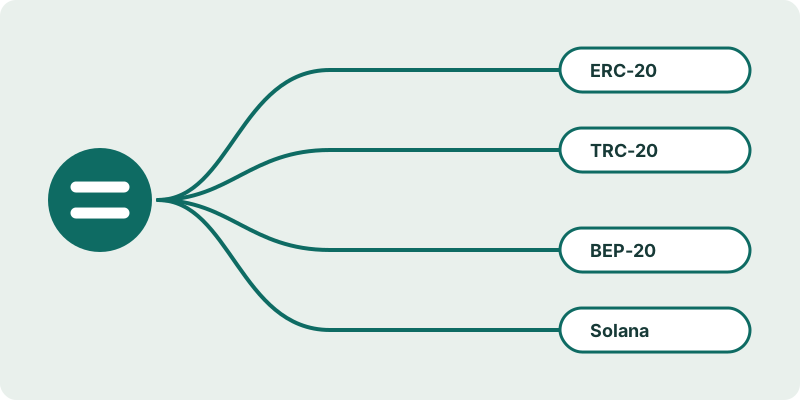
Tether networks at casinos: ERC-20, TRC-20, BEP-20 and Solana
One coin does not mean one address. Tether is issued on many ledgers, each holds its own token, and a casino cashier accepts only the ones it has set up. This page takes the four common routes apart, shows how to tell them from each other, and records which of the twelve operators named which.
What follows a transfer sent down the wrong route is a separate subject and is not covered here; the point of this page is how to choose.
What is the difference between Tether and USDT?
Tether is the issuer's name and the name of its family of dollar-linked tokens. USDT is the ticker of the dollar one. Casinos write one or the other, and some write both in the same cashier, so a reader who sees Tether in one place and USDT in another is looking at the same coin.
The issuer aims to keep each token near one US dollar. That is a promise by a company, not a deposit in a bank, and it applies equally on every network.
Is TRC-20 USDT the same as USDT?
It has the same issuer and ticker, but it is a different token. TRC-20 is the token standard on Tron, ERC-20 on Ethereum, BEP-20 on BNB Smart Chain. Solana's tokens do not carry a standard name in cashiers, which write plain Solana.
The difference is concrete. Cloudbet's configuration points the Ethereum entry at a contract ending 13D831ec7 and the Tron entry at one beginning TR7NHq: two contracts, two ledgers, one ticker. A balance on one cannot be spent on the other; moving between them takes an exchange or a bridge, not a click.
Which networks carry Tether, and who names which
The table lists the networks that at least one of the twelve operators named for Tether, with the shape of the address on each and the operators that wrote the network down. Names are the operators' own spellings; BNB Smart Chain and Binance Smart Chain are one network, as are the Tron and TRC-20 labels.
Networks that at least one of the twelve operators named for Tether
Look first at the screen that holds it, because wallets and exchange apps label the network next to the coin. If the label is hidden, the address helps only partly. An address starting with T is on Tron. An address of 0x followed by forty hexadecimal characters exists on Ethereum, BNB Smart Chain, Polygon and Avalanche alike, and no look at the string tells those apart. Solana addresses are 32 to 44 letters and digits with no prefix.
A block explorer settles it. Each network has its own: etherscan for Ethereum, bscscan for BNB Smart Chain, tronscan for Tron and solscan for Solana appear in Duelbits' own table. A transaction pasted into the wrong explorer is simply not found there.
Which network is better for USDT, ERC-20 or TRC-20?
The question assumes you can choose freely, and you can choose only from the networks present on both sides of the transfer: the casino's deposit screen and the app you send from. Where more than one remains, the choice is about the chain's own token, which pays the fee, about the minimum on that route and about how many confirmations the operator waits for.
Common advice is that Tron suits small, frequent transfers and Ethereum costs more when it is busy. The operators we read do not publish a comparison, so we do not either. The one worked example is BetFury's, which shows ETH costing nearly ten times as much on ERC-20 as on Arbitrum; it is about Ethereum, but the principle that the route sets the price carries over.
Fee and speed differences
A transfer fee is paid in the chain's own token, not in Tether: ETH on Ethereum, BNB on BNB Smart Chain, TRX on Tron, SOL on Solana, POL on Polygon. A wallet with plenty of Tether and none of the gas token cannot send it.
Speed is two things. The chain produces blocks at its own pace, and the operator decides how many to wait for before crediting. BitStarz's page data sets 19 confirmations for Tron and 10 for Ethereum, so the count of confirmations alone does not say which deposit lands first. Roobet states three for Tether deposits without naming a network.
How to deposit at a USDT casino
Open the cashier and choose Tether, then read the list of networks it offers. Compare it with the list in the app you send from and keep only what appears in both. Pick one, copy the address the cashier shows for that network, and copy the memo as well if the screen shows one. Compare the first and last characters of the address before you confirm.
Then wait for the confirmations the operator requires. If the amount matters, a small first transfer proves the whole route before the large one follows, at the price of a second fee.
What the twelve operators wrote
Six name networks for Tether in some form. Cloudbet lists seven and Stake five, with a refusal list besides; Vave names three and gives each its own minimum; Duelbits has two table rows and a third network in its warning; BitStarz names two in its page data; Rollbit files Tether under ERC-20.
Three name the coin and leave the route to the cashier: Roobet, BetFury and Sportsbet.io. Three could not be confirmed: BC.GAME does not name Tether in what it shows, FortuneJack's pages did not open to us, and CoinCasino is a name we could not tie to one operator. None of those three is a statement that the coin is refused.
Questions about Tether networks
Which USDT network is better, ERC-20 or TRC-20?
Neither is better as such. The right one is the one the casino accepts and your sending side offers; after that it is a question of the fee token you hold and the minimum on that route.
How do I know if my USDT is ERC-20 or TRC-20?
Read the network label on the screen that holds it. An address starting with T belongs to Tron; one starting with 0x could be any of several networks, so the address alone cannot tell you.
Is USDT TRC-20 the same as USDT?
It is the same issuer and ticker on a different ledger. Each network carries its own separate token.
Do all casinos accept the same USDT networks?
No. Among the twelve read here the lists run from one named route to seven, and several name none.